
An essential tool for putting out fires is a fire extinguisher. Despite the small size, they are crucial for the home safety strategy. You need to know the parts of fire extinguishers and always keep them accessible at hand in areas where the fire is likely to spread.
Different Types of Fire Extinguishers.
Class A Fire Extinguisher:
Wood, dust, grains, paper, and other solid flammables will all be put out by this specific class of extinguishers.
Class B Fire Extinguisher:
They will work with flammable liquids, such as paint, grease, and petroleum oil.
Class C Fire Extinguisher:
They will extinguish flammable gas and are propane, methane, and butane.
Class D Fire Extinguisher:
Magnesium, lithium, sodium, and other flammable metals will be covered in this particular class.
Class E Fire Extinguisher:
They will put out the fire caused by cooking fats and oils.
Class F Fire Extinguisher:
On electrical fires, they are helpful.
Spare Parts of Fire Extinguishers
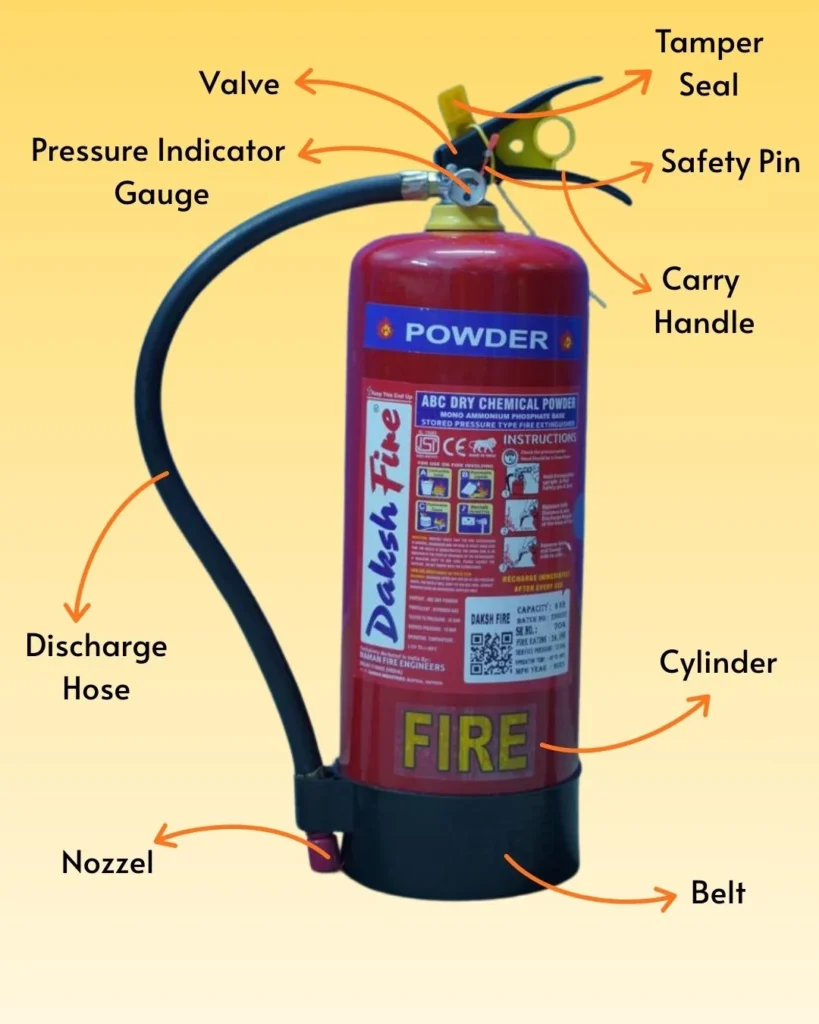
Now let’s focus on the spare parts for the fire extinguishers. They are:
Discharge Hose
The extinguishing agent can travel through the tank and get to the fire’s base because of the hose. The agent’s flow can be directed by users.
Nozzle
The extinguishing agent spreads via the hose’s conical end. The product is simple to find; you may get it from nearby vendors of fire safety equipment or get it online.
Pressure Indicator Gauge
It is a little round gauge that is fixed to the valve assembly’s exterior. The market makes it easily accessible.
During the fire, the gauge keeps the pressure constant while releasing the agent. The gauge’s arrow will be green if it is correctly charged. It is overcharged and could blow up if the needle heads towards the right of the green. It is undercharged if it is to the left.
Valve
It is a crucial component that regulates the agent’s flow. The operational lever and carry handle are connected via the valve.
Carry Handle
The carry handle is one of the replacement parts. The fire extinguisher is simple to hold, raise, and carry because of the handle.
Safety Pin
It is frequently used as a locking pin and placed inside the valve section to stop unintentional squeezing.
Tamper Seal
It helps in keeping the pull pin in place.
📢 Follow us on Instagram and stay updated with the latest fire safety tips, equipment insights, and emergency readiness advice.